Proxpert Legal Solutions
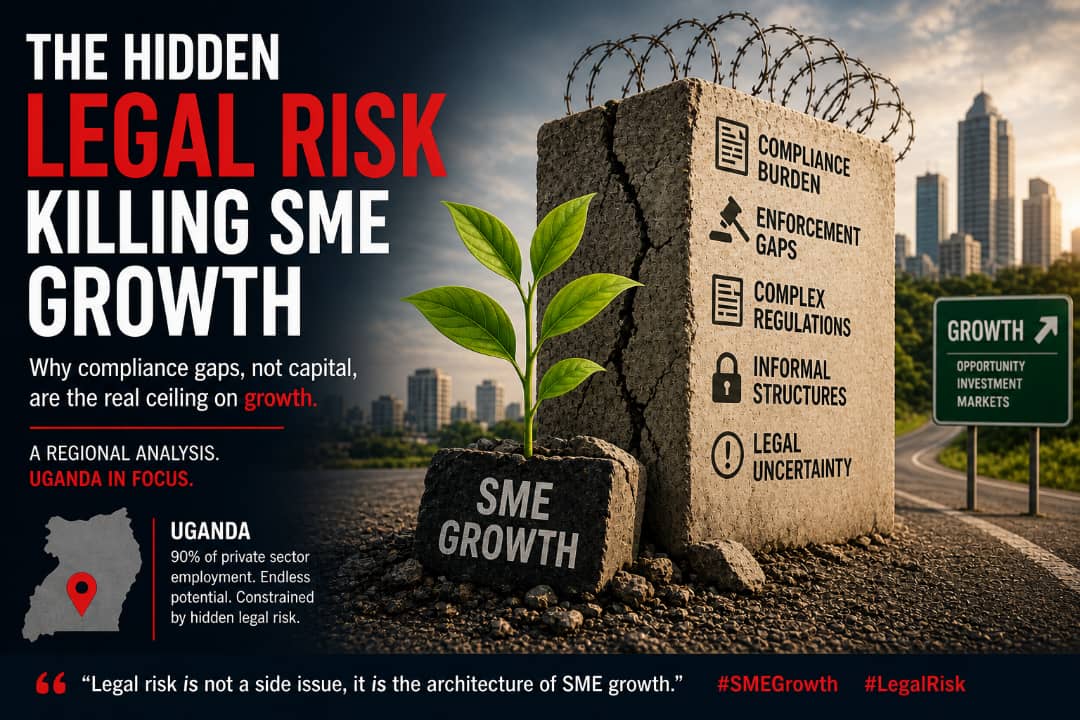
The Hidden Legal Risk Killing SME Growth in Uganda
Why compliance gaps, not capital, are the real ceiling on growth
Introduction: The Misdiagnosis of SME Failure
Across East Africa, the narrative around SME failure is stubbornly consistent; lack of capital, limited access to finance, infrastructure gaps. But beneath these visible constraints sits a quieter, more corrosive force. Legal vulnerability.
In markets like Uganda, where SMEs contribute roughly 90% of private sector employment and a significant share of GDP, their failure is not just a business problem, it’s a structural economic risk. And yet, the legal dimension of that failure remains under-analysed.
The Real Problem: Operating in the “Legal Grey Zone”
A defining feature of SMEs in Uganda and across much of East Africa is partial or informal compliance. Not outright illegality, but not full compliance either. Something in between. Businesses registered but not tax-compliant, tax-compliant but not contractually protected, licensed but operating without enforceable agreements or digitally active but legally undefined.
This “grey zone” isn’t accidental, it’s adaptive. It emerges from high compliance costs, complex regulatory processes, weak enforcement consistency and limited legal literacy. In Uganda alone, over 90% of informal businesses are not registered with the Uganda Registration Services Bureau (URSB), effectively excluding them from legal protections. That exclusion has consequences.
Legal Risk as a Growth Ceiling
Most SMEs don’t fail dramatically. They stall, and legal risk is often the invisible ceiling.
1. Inability to Enforce Contracts
Without proper documentation or legal structure, SMEs cannot enforce supplier agreements, struggle to recover debts and operate on trust instead of enforceability. Even where courts exist, litigation delays and backlog reduce practical access to justice, pushing businesses toward informal dispute resolution or silent losses.
2. Exclusion from Formal Markets
Legal informality locks SMEs out of government procurement, institutional financing and cross-border trade opportunities. Despite public procurement accounting for a major share of Uganda’s economy, SMEs capture only a fraction due to strict compliance and qualification barriers. So they stay small not by choice, but by structure.
3. Regulatory Arbitrage and Its Consequences
Many SMEs deliberately operate outside full compliance to survive; avoiding tax burdens. skipping licensing layers and bypassing reporting requirements. But this creates a paradox. The same legal shortcuts that enable survival prevent scale, because growth requires formal contracts, bankable records, investor confidence and regulatory trust. None of that exists in the grey zone.
4. The Compliance Shock Problem
Even SMEs that formalize face a second wave of risk: ongoing compliance. From annual returns to tax filings, regulatory obligations are continuous and often misunderstood. Failure leads to penalties, deregistration risks, and reputational damage, which quietly drains already thin margins.
The Digital Economy: A New Layer of Legal Exposure
East Africa’s digital boom, especially in fintech and platform-based services, has introduced a new kind of legal fragility. Uganda’s legal framework is fragmented across multiple regimes, with no consolidated digital economy law. That means SMEs navigating data protection, consumer rights, intellectual property and platform liability are often doing so blindly, and yet the faster SMEs digitize, the faster they accumulate unseen legal risk.
Systems Built for Compliance, Not Accessibility
Uganda does not lack laws. If anything, it has too many. Too fragmented, too complex, too poorly coordinated. SMEs face lengthy registration processes, overlapping regulatory bodies, inconsistent enforcement and high perceived cost of compliance. This complexity actively discourages formalization, pushing businesses into informality because compliance becomes a burden, not an enabler, and the law becomes a barrier, not infrastructure.
What Needs to Change
If SMEs are to scale and not just survive, Uganda needs a shift in legal thinking.
1. From Compliance to Enablement
Legal frameworks must be simplified, digitized and integrated.
2. Legal Literacy as Infrastructure
SMEs don’t just need capital. They need contract awareness, tax clarity and regulatory navigation skills. Legal ignorance is no longer harmless. It’s expensive.
3. Embedded Legal Support
The future isn’t traditional law firms waiting for disputes. It’s preventive legal structuring, embedded advisory, and scalable legal tech solutions.
Conclusion: The Cost of Ignoring Legal Risk
Capital does not scale broken structures, and most SMEs in Uganda are structurally broken, not operationally weak. Legal risk is not a side issue. It is the architecture of SME growth. Ignoring it means businesses remain small. Addressing it unlocks entire economies.
This article is for general informational purposes only and does not constitute legal advice. For advice tailored to your specific circumstances;